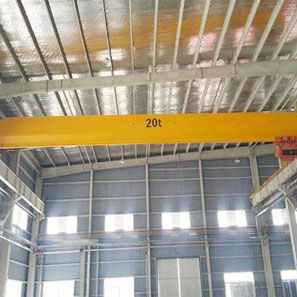
In industrial production, cranes are indispensable material handling equipment. However, many companies focus solely on “lifting capacity” and “span” during procurement, overlooking a core parameter that dictates equipment lifespan, safety, and long-term operational costs: the Duty Class.
Choosing the wrong duty class can lead to frequent breakdowns and soaring maintenance costs. In severe cases, it can even cause safety incidents. Today, we’ll break down the differences between Duty Classes A3, A5, and A7 to help you make the right selection and ensure every dollar of your investment delivers maximum value.
What is a Crane Duty Class?
A crane’s duty class is a comprehensive indicator of its operational intensity. It is determined by two core factors:
Utilization Class: The total number of working cycles over the crane’s design life (how frequently it is used).
Load Spectrum: The severity of the loads being lifted (how heavy the loads are).
According to national and international standards (e.g., ISO 4301), crane duty classes range from A1 to A8. Among these, A3, A5, and A7 represent the most critical dividing lines in industrial applications.
Core Differences: A3 vs. A5 vs. A7
Class A3 (Light Duty): Ideal for occasional use with lighter loads. Annual operating hours are typically under 500, with 3 to 5 cycles per hour. Common scenarios include equipment installation, maintenance workshops, and backup lifting in warehouses. It features standard motors, soft-gear reducers, and conventional wire ropes, offering a low initial investment for low-frequency tasks.
Class A5 (Medium Duty): Designed for regular operations at moderate frequencies. Annual operating hours range from 1,000 to 2,000, with about 10 cycles per hour. Typical applications include machining, assembly lines, and general manufacturing. It offers excellent cost-performance, featuring VFD motors (optional), hard-gear reducers, and reinforced structures.
Class A7 (Heavy Duty): Built for high-intensity, continuous operations. Annual operating hours exceed 4,000, with 20 to 40+ cycles per hour. Key applications include metallurgy, casting, port terminals, paper mills, and continuous production lines. It boasts superior lifecycle reliability through specialized metallurgical motors (H-class insulation), dual braking systems, high-strength steel, and high-safety-factor wire ropes, despite a higher initial investment.
A 3-Step Guide to Precise Selection
Assess Operating Frequency: If you only occasionally lift equipment or use the crane as a backup (under 2-3 hours a day), A3 is sufficient. For standard factories operating 8 hours a day with regular production rhythms, A5 is the golden standard. For 24/7 shifts or over 20 cycles per hour, A7 is mandatory to prevent rapid equipment burnout.
Evaluate Load Conditions: Even if the frequency is low, if you consistently operate near the rated capacity (e.g., lifting loads over 90% of the maximum weight), you should upgrade by one class. For instance, if your A3 scenario involves continuous full loads, opt for A5 directly.
Consider Special Environments: For high-temperature, high-dust, or corrosive environments (like metallurgy or chemicals), you must choose specialized A7 or A8 classes with heat-resistant motors and special protection. For precision assembly, where positioning accuracy and smooth operation are critical despite lower frequencies, a European-style A5 with VFD control is recommended to avoid mechanical shock.
Pitfall Guide: The Cost of Choosing the Wrong Class
Never “Underspec” (Small Horse Pulling a Big Cart): Using an A3 crane for A5/A7 tasks will lead to motor burnout, broken reducer gears, main girder fatigue cracks, and a 3-5x increase in wire rope breakage. This creates severe safety hazards, and manufacturers typically void warranties in such cases.
Avoid “Overspec” (Big Horse Pulling a Small Cart): Using an A7 crane for A3 tasks is safe but inefficient. Initial procurement costs can be 30%-50% higher, and the increased structural weight may require costly upgrades to your factory’s support beams. It is simply overkill with a poor return on investment.
Why Choose Us?
We know that every crane is the lifeline of your production line. We don’t offer one-size-fits-all configurations; we provide tailored solutions.
Free Operational Diagnostics: Our professional engineers conduct one-on-one consultations, analyzing your facility layout, production processes, and shift schedules to accurately calculate your required duty class.
Transparent Configuration Lists: Specifications for A3, A5, and A7 are clear and transparent. Brands and models for motors, reducers, and wire ropes are fully disclosed—no cutting corners.
Full Lifecycle Service: From selection and installation to annual inspections, we support your equipment throughout its entire design life.
Still struggling with the selection? Don’t buy equipment based on guesswork. Choosing the right duty class ensures both safety and cost savings. Contact us today for a free selection proposal!
If possible, kindly suggest please your working industry/process, working pressure, working medium, etc. Given detailed request helps to gain better-matched customized solution. Thanks for your patience.
your request will be responsed within 3 hours, kindly pay attention to your email please.