In chemical, refining, and pharmaceutical workshops, a spark from motor commutation, high temperatures from brake friction, or the moment of wheel impact can all become ignition sources in explosive atmospheres. But an explosion-proof crane is not a standard product—equipment marked “Ex d IIB T4” may be completely unsuitable in a hydrogen environment. The first step in selection is not tonnage and span, but understanding where the “hazard” lies on site.
I. Determine the Explosion-Proof Rating First
Take Ex d IIB T4 as an example: “d” denotes flameproof enclosure—the housing can withstand an internal explosion without igniting the external atmosphere; “IIB” applies to common media such as ethane, propane, benzene, toluene, and methanol; “T4” means the maximum surface temperature does not exceed 135°C.
Ex d IIC T4 extends coverage to the most challenging gases including hydrogen, acetylene, and water gas. For hydrogenation or acetylene processes, IIB is far from sufficient.
The most common mistake: using IIB where IIC is required. Hydrogen has extremely low ignition energy, and flameproof enclosure gap design for IIC differs completely from IIB; conversely, selecting IIC for methanol or toluene media only adds cost and lead time.
II. Gas Explosion Protection and Dust Explosion Protection Are Two Different Logics
Gas explosion protection focuses on preventing internal explosions from escaping or limiting energy; dust explosion protection focuses on preventing dust from entering equipment and controlling surface temperature to avoid igniting accumulated dust. Electrical equipment for dust environments typically uses enclosure protection type “t” or intrinsic safety type “i,” which differ completely in structure and certification from type “d” flameproof for gas environments.
For mixed environments (such as coke pools or coal pulverizing workshops), confirm whether the equipment covers both explosion protection types—a single gas explosion-proof certificate is not enough.
III. Mechanical Components: Explosion Protection Goes Beyond Electrical
Wheels and rails: In hazardous areas, wheel treads and flanges should use stainless steel or non-sparking materials; cable trolley rollers and limit switch strikers should be copper.
Brakes: Friction surface temperatures during frequent braking may far exceed the T4 limit of 135°C; use high-temperature-resistant friction materials or control braking frequency.
Static accumulation: The entire machine requires reliable grounding, forming a continuous static-dissipating path from bridge and end carriage to the hook block.
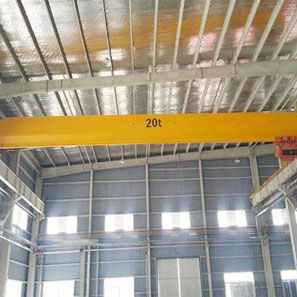
Actual configuration of a 30-ton explosion-proof double-girder crane at a chemical plant: beyond explosion-proof motors and control cabinets, it included spark-free wheels, anti-static grounding system, explosion-proof limit switches, and explosion-proof lighting—each item a necessary component of whole-machine explosion-proof certification, not an option.
IV. Two Easily Overlooked Site Conditions
Ambient temperature and derating. Flameproof enclosures impede heat dissipation. If ambient temperature persistently exceeds 40°C or the equipment is exposed outdoors, motors must be derated according to actual temperature. A Middle East refining project required adaptation to 50°C, with H-class insulation and increased heat dissipation area. Reporting only “normal environment” without mentioning high temperature means frequent summer trips that are too late to fix.
Corrosion combined with explosion protection. Corrosive gases attack flameproof enclosure joint surfaces; rust or scratches on flameproof surfaces cause excessive gaps and directly invalidate explosion protection. Corrosive environments require additional coating grades and flameproof surface anti-corrosion treatment—ordinary anti-rust paint cannot solve this.
V. Selection Checklist: Five Questions That Must Be Confirmed
Hazardous area classification: Zone 0, 1, or 2? For dust environments, Zone 21 or 22? Zone 1 has the highest equipment protection level requirements.
Media type and group: What specific gas or dust? Hydrogen and acetylene correspond to IIC; ethylene and propane to IIB. Confirm against the media table—never guess from experience.
Temperature class: What is the media’s ignition temperature? T4 covers most common media; low-ignition-temperature media such as carbon disulfide require T5 or T6.
Additional environmental conditions: Maximum ambient temperature, corrosive media, outdoor use, whether dust accumulation may exceed 5 mm.
Certification requirements: Domestic projects require explosion-proof certificates and whole-machine explosion-proof certification; export projects require confirmation that IECEx or ATEX certificates are accepted by the destination country.
The value of an explosion-proof crane lies in every detail that could produce sparks or high temperatures being carefully addressed—from flameproof surface gaps to wheel materials, from motor derating to grounding continuity. We welcome your area classification, media type, and environmental conditions, and will provide explosion-proof rating recommendations and whole-machine configuration solutions based on actual working conditions. The right explosion-proof crane starts with accurately describing the “hazard.”
If possible, kindly suggest please your working industry/process, working pressure, working medium, etc. Given detailed request helps to gain better-matched customized solution. Thanks for your patience.
your request will be responsed within 3 hours, kindly pay attention to your email please.