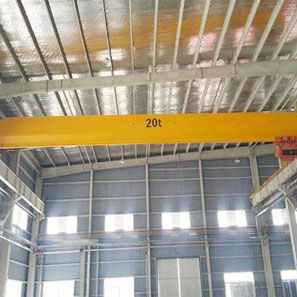
Overhead cranes are the core equipment in industrial material handling. When choosing between single-girder and double-girder models, companies must comprehensively evaluate their actual working conditions, budget, and production capacity.
1. Core Differences: Structure and Performance
Structure and Stability
A single-girder crane features only one main girder with the hoist suspended below. Its compact structure, lightweight design, and low wheel load place minimal demands on the building’s structural bearing capacity. However, it has weaker torsional resistance under heavy loads and is prone to swinging.
A double-girder crane utilizes two parallel box-type main girders, with the trolley running on rails above the girders. This rigid framework provides superior bending and torsional resistance, ensuring extremely smooth operation and high positioning accuracy under heavy loads.
Load Capacity and Duty Class
Single-girder cranes are generally suitable for loads up to 20 tons (customizable up to 32 tons) and A3-A5 duty classes (light to medium duty), making them ideal for intermittent, low-to-medium frequency lifting operations.
Double-girder cranes cover load capacities ranging from 5 tons to several hundred tons, typically falling into A5-A8 duty classes (heavy to extra-heavy duty). They are fully capable of handling 24-hour continuous, high-frequency heavy-duty operations.
Space Utilization and Cost
Single-girder cranes effectively reduce the required headroom in a building, saving initial construction costs. Furthermore, their procurement, installation, and maintenance costs are significantly lower than those of double-girder cranes.
Although double-girder cranes require a higher initial investment, they offer greater lifting heights and a longer service life, delivering superior long-term economic benefits in heavy-duty applications.
2. Application Matching: Which Model Fits Your Workshop?
Ideal Scenarios for Single-Girder Cranes:
Light to Medium Manufacturing and Assembly: Such as hardware processing and electronics assembly, involving lighter workpieces and moderate operational frequency.
Warehousing and Logistics: For loading, unloading, and stacking lightweight goods, prioritizing fast response and low operating costs.
Retrofitting Older Facilities: Where headroom is limited or structural load-bearing capacity is restricted. Their lightweight design and low wheel load eliminate the need for large-scale structural reinforcement.
Small Maintenance Workshops: For loads under 10 tons with limited budgets, meeting basic lifting requirements.
Mandatory Scenarios for Double-Girder Cranes:
Heavy Equipment Manufacturing: Such as automotive and parts manufacturing, and construction machinery, requiring loads ≥16 tons and frequent operations.
Metallurgy and Casting: Handling high-temperature molten metals with 24-hour continuous operations and extremely high safety redundancy requirements (A6-A7 specialized double-girder cranes are required).
Large Spans and High Lifts: For factory spans exceeding 20 meters or applications requiring high lifting heights (e.g., shipyards and large automated warehouses).
Precision Manufacturing: Handling aerospace components and precision molds, demanding extremely smooth operation and precise positioning (frequency-controlled European-style double-girder cranes are recommended).
3. Selection Decision Guide
Evaluate Core Parameters: Clearly define the maximum lifting weight (with a 10%-20% safety margin), span, and lifting height. If the load capacity is ≥16 tons or daily operations exceed 60 cycles, opt for a double-girder crane.
Calculate Duty Class: Choose a single-girder crane for single-shift, intermittent operations. For multi-shift, continuous assembly line operations, a double-girder crane is mandatory.
Consider Special Working Conditions: For environments involving high temperatures, high dust levels, flammable/explosive atmospheres, or strong corrosion, specialized double-girder cranes with the corresponding protection ratings are required, regardless of the tonnage.
Single-girder cranes are economical and flexible, serving as reliable assistants for light industry and warehousing. Double-girder cranes are robust and powerful, acting as a solid backbone for heavy industry and high-end manufacturing.
If you have any doubts during the selection process or require customized solutions for special working conditions, please feel free to contact our technical team.
If possible, kindly suggest please your working industry/process, working pressure, working medium, etc. Given detailed request helps to gain better-matched customized solution. Thanks for your patience.
your request will be responsed within 3 hours, kindly pay attention to your email please.