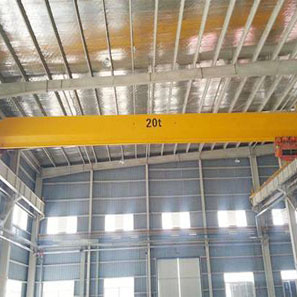
Double girder cranes are core equipment for industrial material handling, widely used in machinery manufacturing, metallurgy and casting, warehousing and logistics, energy and power, and other industries. Facing the numerous brands, models, and configurations on the market, how to select a double girder crane that is cost-effective, well-suited to working conditions, and stable in long-term operation is a critical issue in enterprise procurement decisions.
I. Why Choose a Double Girder Crane?
Compared with single girder cranes, double girder cranes offer the following significant advantages:
Strong load-bearing capacity: Rated lifting capacity ranges from 5 tons to 800 tons, and can even be customized to over 1,000 tons, suitable for heavy-duty working conditions.
Large span: Standard spans range from 10.5 m to 34 m, with stability far exceeding that of single girder models in large-span scenarios.
High lifting height: The hook can be lifted to over 50 m, meeting the operational needs of deep pits and high-rise workshops.
Smooth operation: The double main girder structure offers high rigidity, resulting in minimal shaking during lifting, with positioning accuracy up to ±2 mm, suitable for precision lifting.
High working class: Supports working classes A5 to A8, capable of adapting to 24-hour continuous high-intensity operations.
Long service life: The structural design life can reach 15 to 30 years, resulting in lower comprehensive costs over the long term.
II. Core Parameters for Selecting a Double Girder Crane
Before purchasing, enterprises need to clarify the following five core parameters, which form the basis of selection:
1. Rated Lifting Capacity
Determine based on the maximum weight lifted in daily operations, and reserve a safety margin of 10% to 20%. For example, if you frequently lift 50-ton loads, it is recommended to choose equipment rated at 55 to 60 tons to avoid sudden overloading that could damage components.
2. Span
This refers to the distance between the centerlines of the two rails and must precisely match the actual dimensions of the workshop. The standard span series includes 10.5 m, 13.5 m, 16.5 m, 19.5 m, 22.5 m, 25.5 m, and 31.5 m. The larger the span, the higher the requirements for main girder strength and rail foundation.
3. Lifting Height
The vertical distance from the top of the rail to the highest point of the hook, typically ranging from 6 m to 22 m. Comprehensive consideration should be given to workshop clearance, material stacking height, and deep-pit operation requirements.
4. Working Class
This reflects the frequency of equipment use and load rate, directly affecting equipment lifespan and long-term operating costs:
A3 to A5 (Light to Medium Duty): Suitable for general machining and assembly workshops, with an average daily operation of 4 to 8 hours.
A6 to A7 (Heavy to Extra-Heavy Duty): Suitable for metallurgy and casting workshops requiring 24-hour continuous operation.
A8 (Super Extra-Heavy Duty): Suitable for extreme high-frequency scenarios such as waste cranes and port operations.
5. Operating Speed
This includes lifting speed, bridge travel speed, and trolley travel speed. Speed requirements are not high for short-distance handling, while higher speeds are needed for long-distance and frequent transfers to improve efficiency. For precision lifting scenarios, it is recommended to choose variable frequency speed control models, which enable millimeter-level precise positioning and anti-sway functionality.
III. Types of Double Girder Cranes
Based on technical approaches and application scenarios, double girder cranes are mainly divided into the following categories:
1. Traditional QD-type Double Girder Bridge Crane
Mature structure with high cost-effectiveness, compatible with various lifting appliances (hooks, electromagnetic chucks, grabs).
Lifting capacity: 5 to 320 tons; span: 10.5 to 31.5 m; working class: A5 to A6.
Suitable for conventional scenarios such as general machining, assembly workshops, and building material yards.
2. European-style Double Girder Crane
Adopts advanced European design concepts, reducing the overall machine weight by over 30% and wheel pressure by 25%, effectively lowering workshop structural costs.
Standard configuration includes fully variable frequency stepless speed control, offering smooth operation, low noise, and high positioning accuracy.
Suitable for precision manufacturing workshops in automotive manufacturing, electronics, aerospace, and other industries.
3. Metallurgy-specific Double Girder Crane
Main girders use heat-resistant steel; motors have insulation class H (resistant to 180°C) and protection rating of IP65 or above.
Equipped with a dual braking system with a safety factor ≥1.5, adapted to harsh working conditions with high temperatures, heavy dust, and high load rates.
Suitable for scenarios such as metallurgical continuous casting platforms and molten steel ladle lifting.
4. Explosion-proof / Corrosion-resistant / Clean-room Double Girder Crane
Customized for special environments such as flammable and explosive areas, corrosive environments, and clean-room workshops.
Explosion-proof models must comply with explosion-proof ratings Ex d IIB T4 or Ex d II C T4; corrosion-resistant models have a protection rating ≥IP55.
Suitable for industries such as chemical engineering, semiconductors, and pharmaceuticals.
IV. Key Factors Affecting the Price of Double Girder Cranes
The price of double girder cranes is influenced by multiple factors. Enterprises should pay attention to the following dimensions during procurement:
Core parameters: Lifting capacity, span, and lifting height directly determine the cost—the larger the tonnage, the wider the span, and the higher the lifting height, the higher the price.
Materials and components: High-strength steel, imported motors (e.g., Siemens, SEW), branded inverters, precision reducers, and other high-quality components have higher costs but ensure long-term stable operation.
Technical configuration: Advanced configurations such as variable frequency speed control, PLC control, remote monitoring, anti-sway devices, and intelligent path planning will increase costs.
Brand and craftsmanship: Well-known brands command a certain brand premium due to R&D investment, welding robots, CNC machining, and perfect testing systems, but offer more reliable quality and service.
Customization requirements: Custom needs such as explosion-proof, corrosion-resistant, high-temperature-resistant, special dimensions, and non-standard spans will increase design and production costs.
Hidden costs: Transportation, installation, commissioning, civil engineering modifications (rail beam reinforcement), annual inspection and certification, etc., should all be included in the total cost calculation.
V. Pitfalls to Avoid When Purchasing a Double Girder Crane
During the procurement process, enterprises should pay special attention to the following four “red lines”:
1. Compliance with qualifications is the baseline
Lifting equipment with a rated capacity of ≥3 tons is strictly regulated as special equipment by the state. Manufacturers must hold a Special Equipment Manufacturing License and corresponding qualifications for installation, modification, and maintenance.
Manufacturers without complete qualifications cannot complete compliant equipment inspection and registration, and the equipment may face the risk of failing annual inspections or being subject to mandatory scrapping.
2. Beware of low-price traps
Many low-price quotations contain hidden issues in core components:
Using ordinary carbon steel instead of high-strength low-alloy steel for the main girder, which is prone to deformation over long-term use.
Using cheap contactors instead of fully variable frequency control systems, resulting in large start-stop impacts that can easily damage precision workpieces.
Using ordinary split-type motors instead of high-efficiency energy-saving motors, which have high energy consumption, are prone to oil leakage, and experience frequent failures.
3. Clarify the scope of quotation
When requesting a quotation, do not focus solely on tonnage. Span, rail foundation, power supply method, usage frequency, and after-sales service boundaries all affect the final price. It is recommended to ask the manufacturer to provide a breakdown of the quotation, clearly specifying three parts: equipment subject, on-site supporting items, and service scope, to avoid additional charges later.
4. Value local service capability
The installation, daily maintenance, and emergency repair of lifting equipment all depend on the manufacturer’s rapid response. When selecting a supplier, key examination whether the service team is locally stationed, whether spare parts inventory is sufficient, and the promised response time for fault resolution. One day of equipment downtime may result in production line losses far exceeding the value of the equipment itself.
VI. How to Choose the Right Double Girder Crane Supplier
When selecting a supplier, it is recommended to conduct a comprehensive evaluation from the following dimensions:
Complete qualifications: Verify the original documents for the full set of special equipment manufacturing, installation, modification, and maintenance qualifications.
Technical strength: Assess whether the supplier has independent design capabilities, in-house R&D and manufacturing capabilities for core components, and technical standards benchmarked against international norms.
Project cases: Check for successful cases in the same industry and under similar working conditions, especially experience cooperating with large state-owned enterprises and government-related projects.
After-sales service: Evaluate whether there is a localized service team, original factory spare parts inventory, and clear commitments on fault response times.
Total lifecycle cost: Do not look only at the unit price of the equipment; comprehensively evaluate long-term operating costs including energy consumption, maintenance, spare parts, and service life.
A double girder crane is not a standardized product that can be simply “bought and used.” Its selection must be deeply integrated with workshop structure, production cycle, environmental parameters, and O&M capabilities. Rational selection delivers greater long-term value than blindly pursuing low prices.
If you are considering purchasing a double girder crane, it is recommended to first clarify your specific working condition requirements, and then contact a qualified professional manufacturer for a free on-site survey and customized solution, allowing the professional team to provide the optimal solution based on your actual situation.
If possible, kindly suggest please your working industry/process, working pressure, working medium, etc. Given detailed request helps to gain better-matched customized solution. Thanks for your patience.
your request will be responsed within 3 hours, kindly pay attention to your email please.