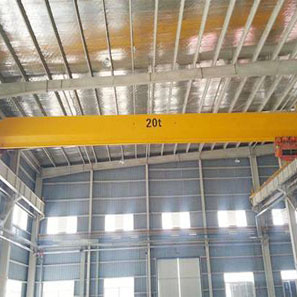
In the global industrial material handling sector, cranes are indispensable equipment. When companies plan new factory construction or equipment upgrades, they often ask: What are the differences between European and Chinese cranes? How should we choose?
In fact, this is not simply a matter of “better or worse.” Rather, they represent different industrial development paths, design philosophies, and value propositions. What truly matters is finding a solution that aligns with your specific working conditions, budget, and long-term operational needs.
European Cranes: “Precision” and “Stability” from Mature Technology
Through decades of industrial application, European cranes have developed a mature technological system characterized by stringent design standards, lightweight construction, modularity, and high reliability.
Representative European brands typically adhere to rigorous standards such as FEM, EN, and DIN. By optimizing structural design, mechanical transmissions, and control systems, they achieve lightweight builds, low energy consumption, smooth operation, and high reliability.
European cranes are highly competitive in industries with demanding stability requirements, such as precision manufacturing, aerospace, and energy.
Of course, these high standards and mature technologies often come with higher initial procurement costs. Therefore, customers must look beyond the equipment price and consider the total cost of ownership, including equipment lifespan, energy consumption, maintenance, and downtime costs.
Chinese Cranes: From Manufacturing Advantage to Technological & Smart Innovation
After decades of development, China’s crane industry has established a complete supply chain and robust manufacturing capabilities. Products have evolved from traditional heavy-duty equipment toward lightweight, smart, green, and customized solutions.
Today, Chinese-made cranes are widely used across industrial manufacturing, steel, energy, logistics, and warehousing. In large-scale engineering equipment and ultra-large-tonnage cranes, Chinese enterprises have also demonstrated strong technical capabilities.
In the fields of overhead cranes, gantry cranes, and European-style cranes, Chinese manufacturers have adopted advanced design concepts. Combined with a mature local supply chain, they have gained significant advantages in product configuration, customization capabilities, delivery efficiency, and cost control.
Meanwhile, the application of technologies such as remote monitoring, intelligent anti-sway, fault diagnosis, and automated control continues to elevate the intelligence level of Chinese cranes.
Core Differences: Chinese vs. European Cranes
1. Design Philosophy
European cranes place greater emphasis on lightweight design, modularity, and total cost of ownership (TCO).
Chinese cranes historically favored heavy-duty designs but have rapidly shifted toward lightweight and European-style designs in recent years, continuously optimizing deadweight, wheel loads, clearance, and energy consumption.
2. Technology and Intelligence
European companies possess deep expertise in precision machinery, transmission systems, and control technologies, resulting in high product maturity and stability.
Relying on a comprehensive manufacturing supply chain, Chinese companies iterate faster in smart control, IoT, remote monitoring, and automation applications.
3. Cost and Service
European brands typically target the high-end market, leveraging advantages in branding, technology, and long-term application experience, though overall procurement costs are relatively higher.
Chinese cranes leverage mature supply chains and economies of scale to offer highly competitive overall solutions without compromising performance.
For overseas customers, an increasing number of Chinese manufacturers are establishing local service and spare parts networks, making equipment delivery, installation, maintenance, and after-sales support more comprehensive.
How to Choose? Look Beyond “Origin” and Focus on “Working Conditions”
When selecting a crane, instead of simply comparing “Made in China” versus “Made in Europe,” focus on these critical questions:
A crane that perfectly fits your working conditions is the only one that truly delivers value.
Chinese and European cranes are not merely in competition.
European cranes hold advantages in precision design, reliability, and standardization thanks to their long-term technological accumulation. Meanwhile, Chinese cranes are demonstrating increasingly strong competitiveness in cost-effectiveness, customization, intelligence, and delivery services, backed by powerful manufacturing capabilities.
With the rise of smart manufacturing and green industry, the competition in the crane sector has shifted from a simple “tonnage and price” battle to a comprehensive contest of performance, energy efficiency, intelligence, and total lifecycle value.
Therefore, the most important question is not “Which country makes better cranes?” but rather: Which solution best suits your factory, your working conditions, and your long-term development needs?
If you are planning to procure or upgrade your crane equipment, please provide your required lifting capacity, span, lifting height, duty cycle, and operating environment. We would be glad to recommend the most suitable crane solution tailored to your actual working conditions.
If possible, kindly suggest please your working industry/process, working pressure, working medium, etc. Given detailed request helps to gain better-matched customized solution. Thanks for your patience.
your request will be responsed within 3 hours, kindly pay attention to your email please.