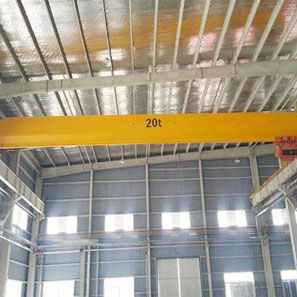
Core Answer: Under identical load capacities, spans, and duty cycles, Chinese-made European-style lightweight cranes typically consume 20% to 50% less energy than traditional models, with an average savings of around 30% across most operating conditions. For models with thorough lightweight optimization, the installed motor power can be reduced to approximately 40% of traditional solutions.
However, “30% savings” is merely a median value. Understanding where this figure comes from and under what conditions it holds true is far more valuable than simply memorizing a percentage.
The energy savings primarily stem from two key areas:
1. Reduced Overall Weight
Through Finite Element Analysis (FEA) optimization and the use of high-strength steel to redesign the main girder cross-section, European-style models reduce their overall weight by 30%–40%, while the trolley weight is reduced by over 30%. The lighter weight synchronously reduces operating resistance and inertial loads, allowing for smaller hoisting and travel motors. For example, a 10-ton European-style single-girder crane typically requires only a 2.2 kW hoisting motor, whereas a traditional model of the same specification usually requires a 3.7 kW motor.
2. Variable Frequency Control
Starts and stops are smoothed using S-curve acceleration and deceleration, drastically reducing inrush current. Empty hooks or light loads no longer require full-power output; the no-load hoisting speed can be reduced by about 50%, contributing to a 20%–30% reduction in overall power consumption. Furthermore, when lowering heavy loads, the system enters regenerative braking mode. The energy feedback efficiency can reach 75%, completely eliminating the traditional method of wasting electrical energy as heat through braking resistors.
Real-World Meter Readings:
A 10-ton European-style crane consumes approximately 3,500 kWh annually, compared to 6,000 kWh for a traditional model of the same specification—a reduction of about 42%.
After equipping a logistics center with regenerative braking, a single crane’s annual consumption dropped from 450,000 kWh to 320,000 kWh (a 29% decrease), saving over 2 million RMB in electricity costs over 5 years.
In a steel plant with continuous heavy-duty operations, energy consumption was reduced by approximately 25%, saving about 120,000 kWh per crane annually.
Clarifying the Boundaries:
The “30% savings” benchmark assumes a comparison under identical load capacities, spans, duty cycles, and operational cadences. In continuous heavy-load scenarios, the energy-saving rate may narrow to 15%–22%. Conversely, in workshops and warehouses with frequent starts/stops and a high proportion of empty-load travel, savings can approach or exceed 30%. It is also worth noting that if a more efficient European-style crane takes on additional lifting tasks, absolute power consumption may not drop year-on-year; however, the energy consumption per unit of lifted cargo will still be significantly lower.
Ultimately, energy savings are not solely the result of a variable frequency drive (VFD); they are the combined outcome of a lightweight steel structure, smaller motors, VFD control, and energy regeneration.
Want to know exactly how many kilowatt-hours your workshop can save annually and how quickly the price premium will pay for itself? Please provide your load capacity, span, daily operating hours, typical lifting frequency, and load rate. We will conduct a customized energy consumption comparison and provide tailored equipment configuration recommendations based on your actual operating conditions.
If possible, kindly suggest please your working industry/process, working pressure, working medium, etc. Given detailed request helps to gain better-matched customized solution. Thanks for your patience.
your request will be responsed within 3 hours, kindly pay attention to your email please.