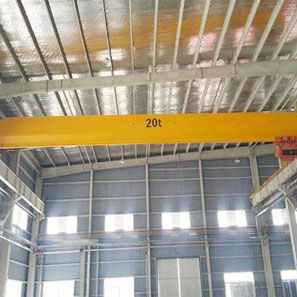
In scenarios ranging from mechanical machining and assembly lines to maintenance workshops, the 5-ton single-girder overhead crane is the preferred choice for lifting operations between 1 and 10 tons. Thanks to its compact structure, lightweight design, cost-effectiveness, and extensive coverage, it has become the go-to solution for most industrial facilities. With the main girder spanning across the workshop, the electric hoist moves laterally along the girder while the end carriages travel longitudinally along the runway rails. This three-dimensional movement ensures complete coverage of the entire operational floor area.
For operations with a daily usage of 4 to 6 hours, where the regular load does not continuously approach the maximum limit, a single-girder configuration offers the best cost-performance ratio. It exerts lower wheel loads, placing less demand on the building’s structural capacity, while also providing greater flexibility in installation, maintenance, and future upgrades. However, “simple structure” does not mean “simple selection.” As core equipment with a service life of 15 to 20 years, every configuration choice made during procurement will be magnified into long-term operational differences.
1. Quality of the Electric Hoist
The electric hoist is the “heart” of the entire crane. It is highly recommended to prioritize wire rope hoists equipped with mature geared motors and high-quality electrical components. A premium hoist ensures smooth lifting, reliable braking, and strong parts compatibility, significantly reducing downtime caused by unexpected failures.
2. Hoisting Control Options
For tasks requiring precise positioning—such as precision assembly, mold closing, or equipment installation—variable frequency drives (VFD) for hoisting are recommended. VFDs provide soft starting/stopping and stepless speed control to protect both the workpiece and the equipment. For general material handling, a standard dual-speed (fast/slow) configuration offers a more cost-effective and balanced choice.
3. Matching the Duty Class
The duty class directly reflects the frequency of use and load conditions. Class A3 is ideal for maintenance workshops or intermittent lifting operations. Classes A4 to A5 are specifically designed for high-frequency operations in machining workshops and assembly lines. Selecting the correct duty class prevents the safety hazards of an undersized crane and avoids the financial waste of an oversized one.
4. Adaptation to Building Conditions
For retrofit projects in older facilities, it is crucial to verify the building’s clear height, runway beam load capacity, and rail straightness. Low-headroom single-girder solutions maximize the effective lifting height in space-constrained environments, making them perfect for workshop upgrades.
Safety and Comprehensive Service
Regarding safety, our 5-ton single-girder cranes come standard with overload limiters, hoisting height limiters, and travel limiters, effectively eliminating the risks of overloading, upper-limit collisions, and boundary overruns at the hardware level.
We provide a full turnkey service covering on-site surveying, solution design, manufacturing, installation, and after-sales training. Whether you require standard configurations for rapid delivery or custom designs for special operating conditions, we have you covered.
Get Your Customized Solution
If you are selecting a 5-ton single-girder overhead crane, please feel free to share your workshop span, lifting height, and daily operating conditions. We will provide a customized selection plan and quotation for free. The right single-girder crane starts with accurately assessing your workshop conditions and choosing the right key configurations.
If possible, kindly suggest please your working industry/process, working pressure, working medium, etc. Given detailed request helps to gain better-matched customized solution. Thanks for your patience.
your request will be responsed within 3 hours, kindly pay attention to your email please.