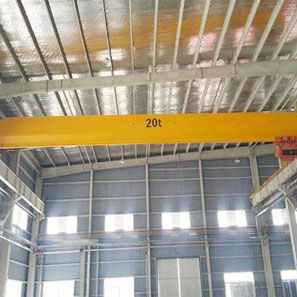
In workshops where one side features existing structural columns or load-bearing walls and the other side needs to span across active work areas, there is often a more economical alternative between full-gantry and single-girder overhead cranes: the semi-gantry crane. One side runs on a ground rail via a support leg, while the other side is supported by an existing building rail or wall-mounted track. With just one support leg and one building-side rail, it achieves full-span lifting coverage.
Compared to full-gantry cranes, semi-gantry cranes eliminate one support leg and one ground rail, resulting in a smaller footprint, lower steel consumption, and less extensive ground foundation modifications. Compared to standard overhead cranes, they do not require both sides of the building to have sufficient load-bearing capacity for runway rails. This makes them particularly ideal for workshop layouts where one side has existing structural support while the other side requires unobstructed floor space. For retrofitting older facilities or upgrading specific production lines, this structure—leveraging one side of the building to save on the other side’s support leg—is often the most balanced solution between investment and spatial constraints.
Ideal Workshop Scenarios
The typical applications of semi-gantry cranes in workshops are concentrated in areas with clearly defined site conditions:
Wall-Mounted on One Side, Spanning Work Areas on the Other: The wall side of the facility has columns or load-bearing structures capable of supporting a runway rail, while the opposite side needs to cover machine tool loading/unloading, assembly stations, or material staging areas. The ground-side leg of the semi-gantry crane occupies only a single rail track, ensuring the main workshop aisle remains unobstructed.
Cross-Line Operations with Space Constraints: In railway freight yards, material storage yards, or cross-line lifting within workshops, full-gantry cranes require ground rails and support legs on both sides. Semi-gantry cranes can utilize existing buildings or elevated structures on one side, reducing foundation construction and footprint on the opposite side.
Retrofitting Older Facilities: If the original facility has existing crane beams or wall-mounted rails that can be reinforced on one side, but ground conditions on the other side are unsuitable for a complete rail foundation, a semi-gantry crane concentrates the renovation efforts on the ground side only. This reduces civil engineering costs and minimizes production downtime.
Temporary or Phased Construction Projects: The ground-side rail can be designed as a detachable or segmented system, making equipment relocation and layout adjustments much more flexible than with full-gantry cranes.
Four Critical Factors to Confirm Before Selection
While the structure of a semi-gantry crane is relatively simple, selection should not be based solely on tonnage and span. The following four factors determine whether the equipment can be installed and whether it will perform well:
Load-Bearing Capacity of the Building-Side Rail: This is the primary prerequisite for selecting a semi-gantry crane. The building-side rail, crane beam, or wall supports must withstand the wheel pressures distributed from the crane’s own weight, rated load, and dynamic load coefficients. Without a structural load calculation, the proposal is invalid. When selecting equipment, provide building structural drawings or rail beam load data so the supplier can accurately calculate wheel pressure distribution.
Ground-Side Rail Foundation and Wheel Pressure: The wheel pressure on the ground-side support leg depends on the crane’s total weight, the load, and the leg structure. The type of rail foundation (concrete strip foundation, steel rail sleepers, or embedded ground rails) and the bearing capacity of the subgrade must be confirmed in advance. Calculating wheel pressure and verifying building-side load capacity are two indispensable preliminary steps.
Span and Headroom: The span of a semi-gantry crane is measured from the center of the ground rail to the center of the building-side rail. The lifting height is jointly restricted by the elevation of the building-side rail, the height of the support leg, and any overhead obstacles. In areas with tight headroom, low-headroom structural designs can maximize the effective lifting height within the same building envelope.
Duty Cycle and Usage Frequency: Daily lifting frequency and typical load weights determine the duty cycle. Intermittent maintenance lifting may require a lower duty cycle, whereas high-frequency operations in machining shops or assembly lines demand a higher duty cycle, which dictates different motor and reducer configurations. Selecting a duty cycle that is too low will increase failure rates, while selecting one that is too high results in wasted investment.
Key Configuration Considerations
Travel and Hoisting Control: For assembly tasks, mold clamping, or equipment installation requiring precise alignment, variable frequency hoisting and travel controls enable smooth acceleration/deceleration and stepless speed regulation. For general material handling, dual-speed configurations offer a more cost-effective choice.
Anti-Sway and Positioning: The single-leg structure on the ground side of a semi-gantry crane is more sensitive to eccentric loading and diagonal pulling. The anti-sway control of the hoisting mechanism and the synchronization of travel directly impact lifting stability. When selecting, confirm whether the hoist and trolley travel feature synchronous control and what anti-sway measures are included.
Safety Devices: Load limiters, hoisting height limiters, travel limiters, wind anchors, and rail clamps (for outdoor or semi-outdoor use) should be confirmed as standard equipment, not optional add-ons. Anti-collision devices for the ground-side leg and end-of-track stops must also be clearly specified.
Corrosion Protection and Environmental Adaptation: For humid, dusty, or corrosive workshop environments, the protection ratings and coating systems for the steel structure and electrical cabinets must be configured according to actual conditions. The ground-side rail and the base of the support leg are prone to water and dust accumulation; drainage and sealing designs should be considered during the proposal phase.
The true value of a semi-gantry crane lies not in its structure being “simpler” than a full-gantry crane, but in allocating limited renovation resources to the side that needs them most—trading existing building-side conditions for one less ground rail and one less support leg. However, this is contingent upon accurately calculating the building-side load capacity, precisely verifying the ground-side wheel pressure, and matching the span, headroom, and duty cycle to the actual operating conditions. Failing to confirm any of these factors in advance will inevitably lead to costly reminders once the equipment is installed.
If you are selecting a semi-gantry crane for your workshop, please provide your building span, building-side rail conditions, ground-side foundation type, lifting height and headroom limitations, average daily lifting frequency, and the weight of your primary lifted loads. Based on your actual site conditions, we will provide targeted recommendations on structural form, wheel pressure calculations, duty cycle, and control configurations—not just a generic tonnage and price quote.
If possible, kindly suggest please your working industry/process, working pressure, working medium, etc. Given detailed request helps to gain better-matched customized solution. Thanks for your patience.
your request will be responsed within 3 hours, kindly pay attention to your email please.