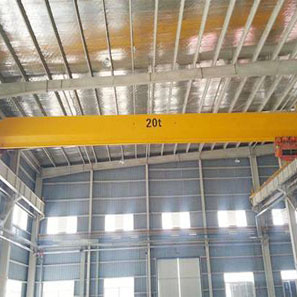
In scenarios such as heavy machinery manufacturing, steel metallurgy, shipbuilding and repair, and large-scale warehousing or logistics hubs, dozens or even hundreds of tons of workpieces, raw materials, and finished products require precise and safe handling every day. The 50-ton overhead crane has become the core equipment for heavy-duty material handling, thanks to its powerful lifting capacity, stable operating performance, and exceptional space utilization.
Commonly known as a “sky car” or “traveling crane,” a bridge crane is a piece of lifting equipment that spans across a workshop or cargo yard. By moving longitudinally along rails (bridge travel) and allowing the hoist trolley to move transversely, it achieves precise 3D material handling.
As a heavy-duty piece of equipment, the core structure of a 50-ton bridge crane includes:
Bridge: Composed of main girders and end carriages, it supports the entire machine and the lifted load. It typically adopts a box-type structure to ensure rigidity.
Hoist Trolley: Integrates the hoisting and traversing mechanisms, responsible for the vertical lifting and horizontal movement of the hook.
Bridge Travel Mechanism: Drives the entire machine to move longitudinally along the workshop rails.
Electrical Control System: Controls the movement of all mechanisms and is equipped with multiple safety protections.
Applications of 50-Ton Overhead Cranes
Equipment in the 50-ton class typically adopts a double girder structure, offering extremely high stability and safety. It is widely used in the following sectors:
Steel & Metallurgy: Handling steel coils, steel blooms, molten iron ladles, and other high-temperature or superheavy loads.
Large-Scale Machining: Lifting heavy machine tool components, molds, and large workpieces.
Energy & Power: Installation of precision heavy components such as wind power equipment and hydro-turbine runners.
Ports & Logistics: Loading and unloading of heavy containers or large bulk cargo.
When procuring a 50-ton overhead crane, do not focus solely on price. The following four technical indicators are directly related to the equipment’s cost-performance ratio and service life:
1. Duty Class (Working Level)
This is the core indicator measuring the crane’s busyness and load state. For 50-ton cranes, a rating of A5, A6, or even A7 (Heavy Duty) is typically required. If your operating conditions involve 24-hour continuous work (e.g., steel mills), you must choose A6/A7 classes; otherwise, motors and gearboxes are prone to failure.
2. Lifting Height & Span
Accurate workshop data is a prerequisite for customization. The span determines the crane’s coverage area, while the lifting height determines the upper limit of the lift. Be sure to reserve sufficient safety margins to accommodate future production needs.
3. Intelligence & Safety Features
Modern 50-ton cranes should be equipped with safety devices such as overload protection, limit switches, and anti-sway functions. For specific applications (e.g., electromagnetic lifting), power-fail magnetic holding functions are essential. High-end models can be equipped with remote monitoring systems to provide real-time data feedback and prevent failures.
4. Customization Capabilities
If your workshop space is limited, or if you require special low-headroom designs, the supplier’s R&D and customization capabilities will be key. Excellent suppliers can optimize designs based on your site conditions to reduce workshop construction costs.
Investing in a 50-ton overhead crane is not just about buying equipment; it is about injecting strong momentum into your production line. Choosing the right model and supplier means lower failure rates, higher production efficiency, and long-term safety assurance.
If possible, kindly suggest please your working industry/process, working pressure, working medium, etc. Given detailed request helps to gain better-matched customized solution. Thanks for your patience.
your request will be responsed within 3 hours, kindly pay attention to your email please.